

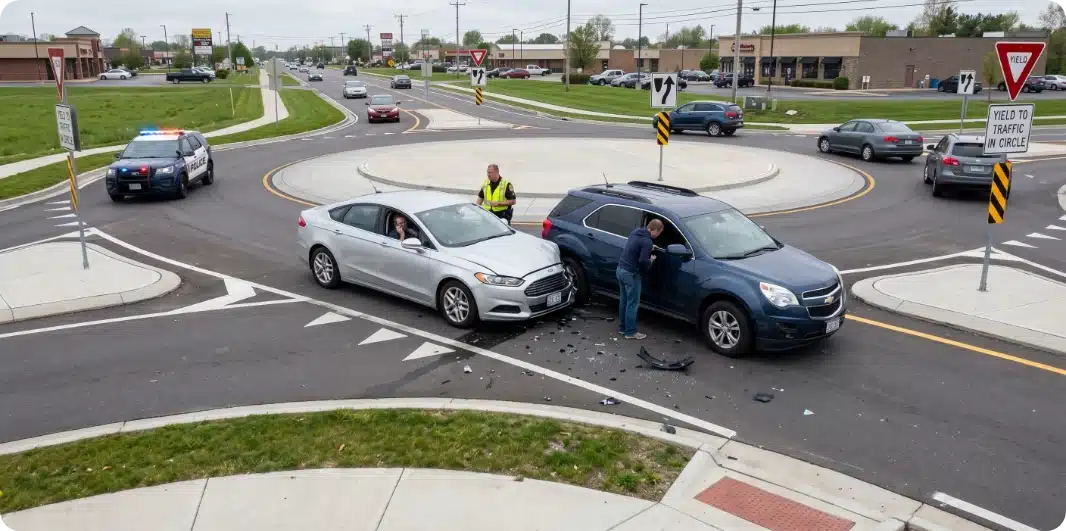
Fault in a roundabout accident often depends on which driver had control of the lane, whether the entering driver yielded, and what evidence exists to prove the vehicles’ positions before impact. As more cities and municipalities throughout Georgia, Alabama, and South Carolina build roundabouts, many drivers are left confused about how traffic patterns work and whether stopping or yielding is required.
One of the most common questions drivers have after a roundabout collision is, “Who had the right of way?” Unfortunately, there is no one-size-fits-all answer. Liability depends on the specific facts of the crash, the position of the vehicles, traffic control devices, witness statements, photographs, video footage, and any available physical evidence. However, certain driving errors frequently lead to roundabout accidents.
Driver Entering the Roundabout Failed to Yield
In most cases, drivers entering a roundabout must yield to vehicles already circulating within it. If a driver enters the roundabout without yielding and collides with a vehicle that has already established itself within the circle, the entering driver is often found at fault. Failure to yield is one of the leading causes of roundabout collisions.
Many modern roundabouts contain multiple lanes. Drivers must remain in their designated lane unless it is safe to change lanes and proper signaling is used. A driver who abruptly changes lanes within the roundabout and strikes another vehicle may be responsible for the collision.
Unlike traditional intersections, traffic within a roundabout is designed to flow continuously. While there are circumstances that may require a driver to stop, unnecessary or sudden stopping can create hazardous conditions. A driver who stops unexpectedly and causes a rear-end collision may bear responsibility for the crash, depending on the circumstances.
Multi-lane roundabouts often require drivers to select the correct lane before entering based on their intended exit. A driver who exits from the wrong lane, cuts across another lane of travel, or fails to follow designated lane markings may be found negligent if a collision occurs.
Roundabouts rely heavily on yield signs, directional arrows, lane designations, and pavement markings to guide traffic safely. Drivers who disregard these traffic control devices increase the risk of causing a collision and may be held liable for resulting damages.
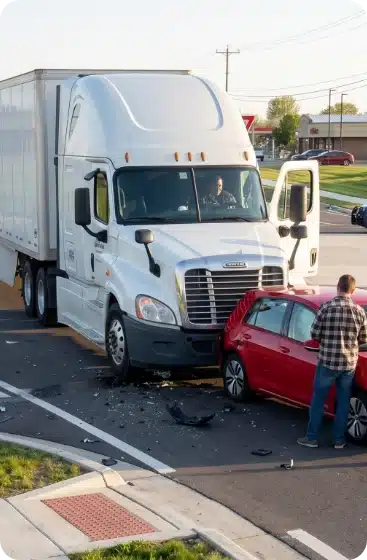
Not every roundabout accident has a clear-cut answer. In some cases, both drivers may contribute to the collision. For example, one driver may have entered improperly while the other was speeding or changing lanes. In Georgia, modified comparative negligence laws may reduce a person’s recovery if they are partially responsible for causing the accident. Determining fault often requires a careful review of photographs, vehicle damage, witness statements, police reports, and available video footage.
Because insurance companies frequently dispute liability in roundabout accidents, gathering evidence at the scene can be critical. Photographs showing vehicle positions, lane markings, traffic signs, and roadway design may help establish exactly how the collision occurred and who was responsible.
Recently, the Mike Hostilo Law Firm had the opportunity to represent a client who was sideswiped while traveling through a roundabout. The liability insurance carrier initially denied responsibility and argued that liability could not be determined because each driver blamed the other. This was despite the responding officer noting in the police report that our client was not at fault for causing the collision.
What ultimately made the difference in this case was the evidence gathered at the scene. Our client wisely took multiple photographs, not only of the property damage to his vehicle, but also of the roadway and traffic layout within the roundabout. Those photographs clearly demonstrated that our client had lawful possession of the lane at the time of impact and strongly supported our position against the insurance company.
Another significant tool the Mike Hostilo team utilized was an independent witness who observed the collision. The witness was identified on the police report and confirmed that our client clearly possessed the lane prior to impact. The witness further observed the negligent driver failing to yield the right of way before striking our client’s vehicle. Our office contacted the witness and obtained an affidavit detailing the facts and observations surrounding the collision. We submitted the affidavit to the insurance company to further bolster our liability position and support our client’s claim.
As a result, the insurance carrier ultimately accepted liability, paid for the repairs to our client’s vehicle, and we were able to maximize the value of his bodily injury claim. If you are involved in a collision near a roundabout, photographs of the scene, lane markings, signage, and vehicle positioning can become critical evidence. These cases often come down to proving which driver properly maintained their lane and followed right-of-way laws.
Another important tip is to obtain information from any independent witness who observed the collision. Independent witnesses can provide statements to the responding officer for the police report and, in some situations, may also execute sworn affidavits detailing what they observed. This evidence can become extremely valuable when an insurance company attempts to deny liability.
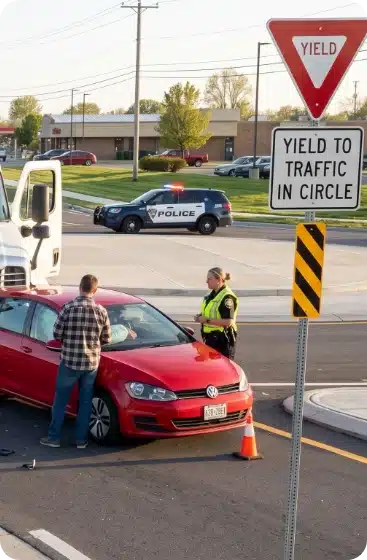
- Photos of vehicle damage
- Photos of lane markings
- Photos of traffic signs
- Photos showing where each vehicle stopped
- Police report
- Witness name and contact information
- Dash camera footage if available
- Nearby business or traffic camera footage if available
Drivers should also remember several important roundabout safety rules. Traffic already circulating inside the roundabout generally has the right of way. Drivers entering the roundabout must yield to traffic already in the circle and always remain alert for pedestrians. Vehicles must travel counterclockwise through the roundabout and should select the appropriate lane before entering based upon the intended exit. Drivers should also use turn signals when exiting to help maintain safe traffic flow and reduce confusion.
Drivers should also remain mindful that not everyone fully understands how roundabouts operate. Some motorists incorrectly treat roundabouts like four way stops, which disrupts the intended flow of traffic and can create dangerous situations. Remaining alert and anticipating driver confusion can help prevent avoidable collisions. Roundabouts are designed to improve traffic flow and reduce severe crashes but understanding the rules and remaining attentive is essential to keeping everyone safe.
*Prior results do not guarantee a similar outcome. Every case depends on its own facts, evidence, and applicable law.
About the Author:
Brandi Allday is the Managing Attorney of the Mike Hostilo Law Firm and is licensed to practice law in both Georgia and Alabama. Since joining the firm in 2018, Brandi has helped oversee thousands of personal injury claims and is dedicated to helping injured clients navigate the legal process while pursuing maximum compensation. Brandi lives in Columbus, Georgia, and earned her undergraduate degree from Columbus State University and her Juris Doctor from Thomas Goode Jones School of Law at Faulkner University. She has extensive experience in personal injury law, law firm operations, client advocacy, and legal strategy. In 2025, Brandi was invited to speak at the Lex Summit Legal Conference, one of the nation’s premier legal technology and law firm management conferences, where she discussed law firm operations and the business of law. As Managing Attorney, Brandi leads a team of attorneys and legal professionals across multiple markets, focusing on exceptional client care, legal excellence, and achieving favorable outcomes for those injured by the negligence of others.